
I have two dogs. A golden retriever named Biscuit who sheds enough in a single afternoon to stuff a throw pillow, and a beagle-mix named Olive who doesn't shed as dramatically but somehow manages to leave hair in places that make no physical sense — the underside of outdoor chair arms, the crevice between cushion and frame, the one spot on the loveseat where nobody ever sits. Together, they've turned our back patio into a situation I did not fully anticipate when we adopted them.
If you have pets and outdoor furniture with fabric cushions, you know what I'm talking about. The hair doesn't just sit on the surface the way it does on a hardwood floor where you can sweep it up and be done. It weaves into the fabric. It gets into the weave of the cushion cover and stays there through rain, through sun, through the wind, through every attempt to remove it. I've spent more money than I'd like to admit on products that promised to fix this problem and mostly didn't. So here's what I've actually figured out after several summers of trial and error.
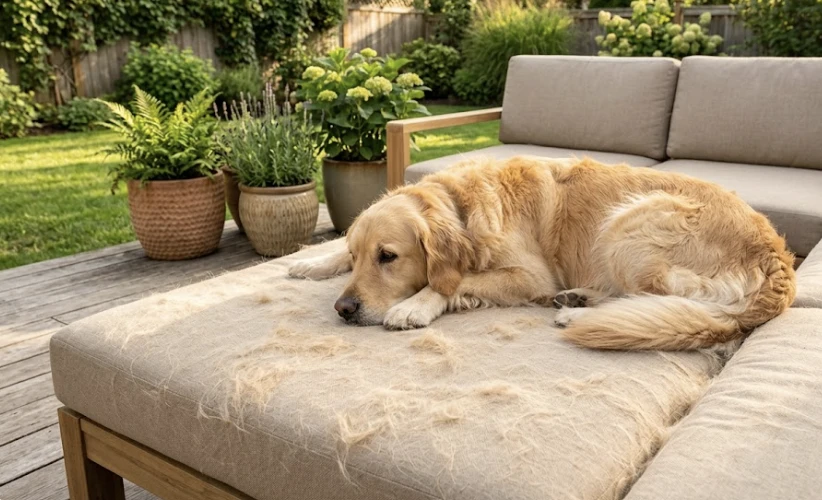
The first thing I didn't understand when we got the patio furniture was that outdoor fabrics — the performance weaves like Sunbrella or the polyester blends that most outdoor cushions use — grab pet hair differently than the velvet or microfiber you might have indoors. Indoor upholstery has pile — surface texture that hair sits on top of or just slightly into. Outdoor performance fabric has a tighter weave structure designed to resist moisture and UV, which is exactly what makes it good at its job and also exactly what makes pet hair dig in and refuse to let go.
Rain makes it worse. When our cushions get rained on — which happens constantly because I never remember to bring them in — the water works the hair deeper into the weave. By the time the cushions dry out, the hair that was sitting loosely on the surface is now embedded. A dry cushion with fresh hair on it is a manageable problem. A cushion that's been rained on twice with a retriever sleeping on it in between is a different situation entirely.
Sun doesn't help either. UV exposure over a season slightly stiffens outdoor fabric, and stiffened fibers grip embedded hair more tightly. By late August, the cushions that started the summer looking manageable have had four months of sun-rain-dog-sun cycles, and the hair situation is genuinely entrenched.
The lint roller is the first thing everyone reaches for. I went through probably thirty of those adhesive roller refills before accepting that they work fine for surface hair on a blazer before you leave the house and are not remotely up to the task of outdoor cushion fabric. The adhesive doesn't generate enough grip on performance weave to pull embedded hair, and the rollers get saturated immediately on a golden retriever cushion. You end up using six sheets to do one cushion and you've moved maybe forty percent of the hair.
The rubber pet hair remover brushes — the ones that work in a back-and-forth motion and are supposed to create static — work better indoors on carpet than they do on outdoor fabric. The mechanism relies on a certain amount of fabric give, and tight outdoor weave doesn't give. I have three of these brushes in a drawer on the patio. I use them occasionally. They're not useless but they're not the solution.
I tried a leaf blower on a particularly bad day after a weekend when both dogs had been sleeping on the cushions through the rain. This was a mistake. It redistributed the hair, spread it to the table surface and the patio floor, and put a certain amount of it in my face. Do not do this.
Duct tape, masking tape, packing tape — all versions of the same problem as the lint roller, just less convenient to use. The tape itself leaves residue on outdoor fabric if you're not careful, which then attracts new dirt.
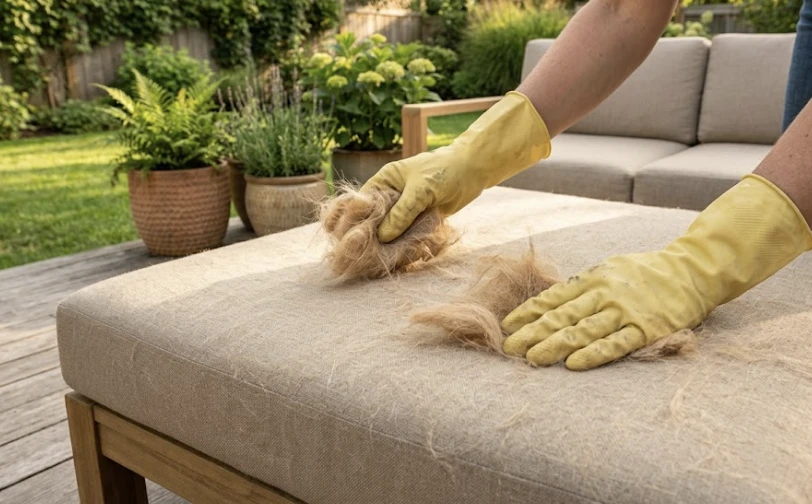
The most effective regular-maintenance tool I've found is a damp rubber glove — specifically a dish-washing glove, the kind with slight texture on the palm and fingers. Run your gloved hand across the cushion surface in one direction with moderate pressure, and the rubber creates enough friction to pull embedded hair out in clumps that you can then collect and throw away. The damp part matters: dry rubber generates static and the hair goes everywhere; slightly damp rubber grabs and rolls it.
For cushion covers that are removable and machine-washable — and many outdoor cushion covers are, check the tag — a wash cycle with a half cup of white vinegar in the rinse helps loosen hair from the fabric before it goes in the dryer. Run the dryer on low heat with a couple of dryer balls. The combination of tumble action and the softening effect of the vinegar-rinse loosens embedded hair better than washing alone. Pull the lint trap after five minutes — it will be full.
A vacuum with a rubber pet hair attachment works better than the standard upholstery tool on outdoor fabric, specifically because rubber creates friction against the weave where plastic bristles just slide over it. The Dyson pet groom tools and the similar aftermarket attachments for other brands make a real difference here compared to whatever attachment came in the box. Move against the grain of the fabric weave rather than with it — you're trying to lift the hair out, not push it in further.
Dogs shed in seasons. The spring shed — when the winter coat comes out — is the worst, and if you're in a climate with real winters, your dog is dropping an alarming amount of fur from March through May. That's also the time of year when you're opening up the patio furniture for the season, which means the cushions that have been in storage are getting saturated with spring shed right at the start of outdoor season.
I've started doing a thorough pre-season cleaning every April before the furniture goes back out. Everything gets the rubber glove treatment, then a vacuum pass, then a wipe-down of the fabric with a barely damp microfiber cloth to pick up the fine hair that the vacuum missed. It takes about an hour for our set, and it means we start the outdoor season with clean cushions instead of trying to catch up all summer.
By August, even with regular maintenance, the cushions have accumulated several months of embedded hair, pollen, general outdoor dust, and whatever Biscuit rolled in during the previous weekend. This is when I've learned that DIY maintenance hits its limit, and it's worth understanding what that limit actually is.
The embedded hair you can remove with a rubber glove is the surface-to-mid layer of the fabric. What's down in the base of the weave, particularly in cushions that have been rained on repeatedly, is beyond what friction-based removal reaches. The same is true for pet dander — the microscopic skin particles that cause allergic reactions — which penetrates to the fiber base and stays there regardless of what you do on the surface.
After two full seasons of our patio cushions getting the full Biscuit-and-Olive treatment, I had them professionally cleaned. The technician used truck-mounted hot water extraction — the same equipment used for indoor upholstery — on the outdoor fabric. The extraction water was the color of weak coffee. The cushions, which I thought were in reasonable shape from my regular maintenance, were apparently harboring considerably more than I'd removed on my own. After cleaning, they were visibly brighter, the fabric texture was different in a way I can only describe as "right again," and they dried within three hours in the sun.
If you're looking into what professional services exist for this — searching for how to remove pet hair from outdoor furniture professionally rather than DIY — the key question to ask any service is whether they have experience with outdoor performance fabrics specifically, because the extraction approach and drying time management is different from indoor velvet or microfiber. Not every upholstery cleaning company works on outdoor fabric.
I'm not going to tell you to keep the dogs off the patio furniture, because that's not happening in our house and probably not in yours either. What I have done is add outdoor furniture covers to the pieces we're not actively using — the loveseat stays covered except when we have people over, so only the main sectional gets the full daily dog exposure. It's not perfect but it reduces the total fabric surface that's accumulating hair.
Throwing a washable outdoor blanket over the dogs' favorite spot and washing it every week or two handles a significant portion of the hair load before it ever reaches the cushion fabric. This sounds obvious but I genuinely didn't think to do it until year three of patio furniture ownership. The blanket collects the majority of what Biscuit deposits during a napping session; the cushion underneath stays relatively clean. Machine washing a $25 throw blanket is considerably easier than deep-cleaning patio cushions.
Grooming frequency matters more for outdoor furniture than indoor, counterintuitively, because outdoor fabrics hang onto hair so much more tenaciously. The two weeks before shedding season peaks — usually mid-March and again in late October if your dog has a fall coat change — are when brushing every other day makes a measurable difference in what ends up on the cushions. It's not glamorous but it's cheaper than cleaning products that don't fully work.
After a few summers of this, my system is: daily brush-off when I notice accumulation, weekly rubber glove pass on high-traffic cushions, pre-season thorough cleaning in April, professional cleaning every second summer or whenever the embedded situation gets genuinely out of hand. It's more maintenance than I expected when we bought the patio set. It's also less frustrating than the alternative of spending money on things that don't work and resenting the dogs, who are objectively worth the trouble.